

Read to you by me: https://trowbridgedispatch.iamaiken.com/p/cardboard-undies-audio
I.M. Aiken spent 2006 as member of a military unit in Iraq as a government civilian. She has a new novel releasing this summer/fall that incorporate her journal entries and ties them to ancestral stories of a soldier during the Reconstruction Period that followed the American Civil War. This story is a revised chapter from that upcoming novel. Links to current events will pop for you. This journal entry is from precisely 20 years ago this month, the author (me) seems to pleading for a description of the end game. Not different from March of 2026. And actually, not too different from 1898 and 1871 America, either, a theme in the upcoming novel. Note that in fictionalizing the journals, the roll of the storyteller morphed from the author to a fictional soldier, and made it a letter home.
Brighid:
Your ancestor, Captain Henry, relates to Killeen, Texas. How’s that for an odd link across a century and a quarter? Your young Henry served as a private soldier near Chattanooga, Tennessee just after the American Civil War. There is a creek near Chattanooga called the Chickamauga. Confederate General Hood originally trained and served in the U.S. Army before rebelling against the United States. He lost his leg near Chickamauga in a battle against the United States Army. Earlier at Gettysburg, he lost the function of an arm. Adding insult to injury, Hood lost most of his battles. He violated his oath, fought against the United States, and proved to be a poor leader. In an effort to appease southern politicians, we named the Army post in Texas after this guy. Fort Hood. You’ve been there with me. One of our nation’s largest Army posts is named for a general of a rebellious army, and a treasonous criminal.
As you research this period of our history, you might keep your eyes open for names that seem heroic and honored, but are actually a hint of old political battles within our country. While fighting here in Iraq, my thoughts explore the closure and healing process that follows civil war.
At the end of our one-year tour here, these soldiers of the Fourth Infantry Division garrisoned at Fort Hood will move to Fort Carson in Colorado. These soldiers, who have been on the go since the wars began, have already been presented with a choice. If a soldier remains with the Fourth Infantry Division, they will return from combat to Texas and immediately move to Colorado. If a soldier decides that Texas and Fort Hood is their forever home, then the soldier must transfer to a different unit. But most of the units at Fort Hood who did not deploy this year will deploy to Iraq next year.
We’ve given our soldiers a Hobson’s Choice. They must decide to move to Colorado or return to combat nearly immediately. Many of the soldiers have already decided to use their mid-tour break to pack up their lives and their families.
If a soldier decides to remain with the Fourth Infantry Division, then they move to Colorado, then they will return to these battlefields within eighteen months. The only relief is retirement, injury, schooling, or end of service. And yet, there are hundreds of serving soldiers here who have already retired or have found themselves in active units during their supposed “terminal leave,” or trapped by stop-loss programs. The Army holds on to skilled and experienced soldiers. I am here with a lot of overweight soldiers, soldiers who have applied to separate from service, and soldiers who filed for retirement more than a year ago. Some do not expect to be released for yet another year.
Since 2003, our government has mobilized this division from Texas to Iraq then back to Texas then back to Iraq. From Baghdad, they will return to Texas, move to Colorado, unpack, then deployed again to Iraq or Afghanistan. I am counting the evolutions on my fingers: one, two, three, four, five, six, seven. That will be seven complete moves of a heavy infantry division in under a decade. A division is approximately fifteen thousand soldiers. Add family, support staff, vehicles, office equipment, households, and sundry… the number of humans involved ranges between sixty and one hundred thousand. In addition to the people, their households, and offices, the moves include artillery, hundreds of M1A1 Abrams tanks weighing between sixty and eighty tons, thousands of Humvees, and thousands of shipping containers.
Young soldiers in our ranks, people my age, have experienced combat action in two countries and have been in a theater of combat for most of their very short careers. When command offers a young soldier a coin or a written statement of praise, they do not appear to care much. Young soldiers, young privates already awarded a Silver or Bronze Star, roll their eyes at being made soldier of the month from their own company. They have already seen multiple combat tours. Tired soldiers seeing years of combat operations in front of them. Letters of recognition fail to instill motivation like they once did.
With Iran in the news with such frequency, and the increasing violence in Iraq, I hope that our government does not expect that this Army to walk into Iran to solve the problems with Iraq. Iran and Iraq battled for a decade in the 1980s. The result was 1,000,000 people dead and a scared battlefield. Back then, Iraq was our friend and Iran held American hostages. Imagine the day when our elected officials announce that we are adding another battlefield. Such a decision will crush the souls and families of this generation of American soldiery.
Four of us got posted to tiny Camp Falcon. It is a short distance from my normal base. All of my stuff remains behind at divisional HQ. I live from my ruck, rotating between two uniforms and a handful of underwear and socks that I either launder in a sink or simply wear into the shower. I wash them with shampoo. I wring them out, then hang them during the night. The following morning, they are dry. Regrettably, my undies hold the shape of whatever I hung them on; they are just that stiff.
I barely sleep at night. I had been excited to have this small building to myself, with its walls and door; I did not feel welcome with the enlisted females as I am the only female officer on this base, and the rules state that I cannot rack out with my own squad because they are all dudes. I failed to understand that dozens of Chinook helicopters come in most nights. Chinooks date back to the Vietnam war. They have two sets of rotors and a loading ramp like a cargo plane. We fly them at night now because they are vulnerable to ground attacks during the day. They are heavy, slow, loud, and explain why this small building remained uninhabited by the soldiers serving here. Nobody wants to sleep in the landing path of Chinooks. Except me, I guess?
Most soldiers rack out in two-story buildings. These two-story buildings are dressed in the khaki-colored stucco that matches our equipment and the soil. The ground story of the building has a layer of tall concrete barriers—called either Texas barriers or Alaska barriers—which resemble the Jersey barriers of highways back home, except they stand three meters tall. Each window on the ground floor has three layers of sandbags. Ringing the buildings between the ground floor and the top floor is an exterior concrete trough that carries basic utilities. Our troops use this trough to carry communications wires and stack sandbags. The second story windows also have three layers of sandbags unless there is an air conditioning unit.
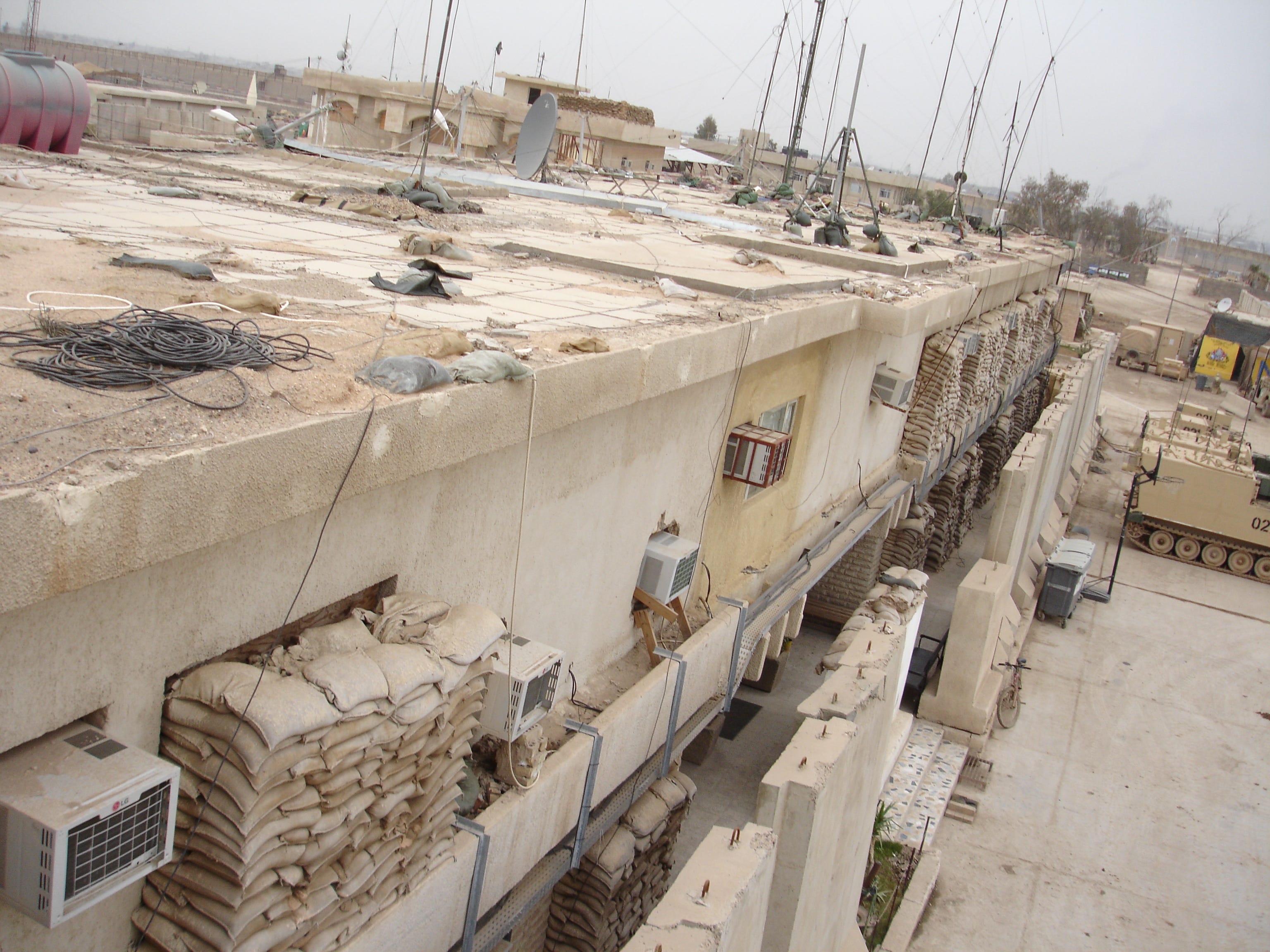
The roof deck of the building is flat and made of concrete tiles on a concrete base. Antenna masts and antenna dishes are weighted down with sandbags. Additionally, one can observe the ghosts of former sandbags. Regrettably, a lot of the bags we have used for making sandbags had been manufactured out of nylon or plastics. The sun destroys these plastics within a few months. The sandbags get bleached, then corrode in the sun. The result is leaking and spilling sand. The dense sand remains in its neat, round pile while the plastic fabric fades to dust. Thereby creating ghosts of former sandbags.
One layer of sandbags slows a bullet, reducing its lethality, but the dust and dirt from the sandbag enters a soldier’s wound which can introduce evil infections. Three layers of sandbags stack with greater stability and stop normal bullets and most shrapnel from IEDs, mortars, rockets, and grenades. As many urban kids know, before joining the Army, sleeping on the floor provides greater protection from bullets.
During my first tour into Iraq, a female master sergeant provided an informal class to female soldiers. One of the lessons was called feet-first. Before dressing, take care of your feet and treat for fungus. Then put on clean, dry socks. Do this before putting on underwear. The little bugs can’t jump through your socks. The little beasties from the feet have a more difficult time traveling to the nether regions covered by the underwear. Listen to the infantry. Another lesson involved urinating into a plastic bottle. She showed us how to make an oblique cut on a plastic water bottle, which, when completed, makes an anatomical match. Stand or squad, she said. Pee, then pour the contents into a bottle with a screw on top. Toss. With the lesson, we joined the world of those who can pee standing up. It makes peeing on a C-130 Hercules, peeing when doing surveillance, and peeing with a small squad of male soldiers just that much easier. It also makes peeing at night easier, too.
Camp Falcon occupies a few city blocks. It has three-story walls, made from Iraqi brick. It already had guard towers, so I assume that this facility was once an Iraqi military post. This is an urban base. The sounds of Baghdad remain constant and close.
The nightly body count in Baghdad approximates fifty citizens. That’s fifty Baghdadi folks, not U.S. troops; Iraqis killing Iraqis. We seem further from an end that we did when I got here. We appear to be traveling backwards, away from peace, the longer we are here. In the summer of 2003, when I deployed here for a few months as a sergeant, I believed we approached the end of the war. Instead, peace keeps retreating from Iraq.
I acknowledge that my foul attitude is due, in part, to living in quarters that would be condemned in any U.S. city. In Iraq, I call it home-for-now. I have made a nest in the corner. I fight with mice, ants, bugs, and spiders to defend my crappy piece of this room.
I noticed a dramatic down-tick in my emotional state when I read about a man in Afghanistan who converted to Christianity. I read that the government of Afghanistan now wants to execute him because of his conversion. In a country where we committed U.S. soldiers, we are faced with a government that wants to execute someone because of a religious preference. I am incensed by this. My stack is blown—as in, remains blown. Aren’t we here to defend freedom? Freedoms of religion and of the press, freedom from unwarranted searches, freedom to vote?
The fact that I carry the Constitution and Bill of Rights with me, even in this miserable place, expresses my desire to stand for these values. I do not wish to have American soldiers fighting to restore power to a government that completely eschews our soldier’s oath.
I know I am in Iraq, but the fluidity between Iraq and Afghanistan amazes me. Between Iraq and Afghanistan is the nation of Iran. Presently, Iraq and Afghanistan are two different battlefields against two different enemies being fought for two different reasons. Yet it is the same few Americans that deploy into, then out of, these two wars. Most Americans do not know the difference. Most Americans cannot point to either of these nations on a map.
I read what I can about Afghanistan. If I am not going there next, I’ll return here. I am certain I will see Afghanistan at least once.
At this moment, NATO is taking over forces in Afghanistan. Our troops are about to fight under a British general for the first time since World War II. At the same time, we are in a diplomatic fracas with the Mayor of Kabul (oh, I mean the “President of Afghanistan,” forgive me). Under Karzai, opium production is better than it has been in decades. Their constitution does not provide for a distinction between state and church, nor does it provide itself the ability to supersede traditional Islamic law. Under the new rulers, Afghans can return to lopping off the hands of thieves and stoning women.
The Taliban’s strict enforcement of Islamic law inspired the destruction of the ancient Buddhist sculptures carved into the mountain side. The Buddhas of Bamiyan were considered idolatry and sacrilegious by these religious zealots. Therefore, the Taliban—then standing as the Afghanistan government—blew them up. They filmed it. They filmed the process of destroying artifacts created in the sixth century. One stood thirty-eight meters tall, the other fifty-five. “One should not let idols stand,” said the nation’s boss, so they blew them up.
Let’s admit that part of the Islamic code remains as rigid and archaic as Leviticus. Imagine a nation run by the rules of Leviticus? If someone decided that America must be a truly Christian nation and follow the teachings of the Christian Bible, where would we be? Yet the U.S. government seems to be stumbling around with our proverbial knickers at our ankles. We must stand for real religious freedom; instead, we support a government that has outlawed converting to Christianity. We plea for a life sentence or an insane asylum in lieu of death. We are negotiating with the government we installed, the government presumed to be more liberal than the Taliban.
Let’s observe that we negotiate the sentence whilst ignoring the underlying law. We have put American soldiers into the line of fire so that this new government can codify laws that limit religious preference. None of this follows the tenants of my oath—our oaths—nor the words written in that slim document in my breast pocket. What is the difference between the Taliban or this new Afghanistan government if they both use the same laws and tactics?
Soldiers express shock, anger, and dismay over this issue. Things heated up on the anniversary of the Invasion of Iraq in March of 2003. Many here thought that Afghanistan was a model for success, a model that demonstrated to all of us how this war in Iraq could come to a good end. Victory by U.S. forces can never, ever tolerate religious persecution. That is the first of our amendments. 1791, the same year Vermont joined the union, the following words were written and accepted as law:
“Congress shall make no law respecting an establishment of religion, or prohibiting the free exercise thereof; of abridging the freedom of speech, or of the press; or the right of the people to peaceably assemble, and to petition the government for a redress of grievances.”
The authors found that freedom of speech and religion where exactly that important. We do not drain our blood, our credibility, our nation’s bank account, and destroy American families so that some damn government can just lock up—or kill—a guy with a Bible, a Koran, a Torah, a Bhagavad Ghita, or any other document. That is not in the bargain. We serve to support our values and our Constitution. We shall not yield the life of a single American soldier to support a government that would execute or imprison a citizen for his religious beliefs.
Reporters in Afghanistan tend to focus on the military as the story: The bodies, the tactics, the weapons. The news has not yet made an issue out of the limitations of the laws in Afghanistan. The reporters, and politicians, need to see past the Humvees and the patrols.
But you have to be here to see beyond. Footage of the most recent bombing is the same here as any other place: flashing lights, a reporter yelling into a mic while wearing a blue flak vest, a bloom of smoke over his shoulder and bits of car and debris all over the place. We’ve seen it. You’ve seen it. It is not news.
We should be reporting on stories that matter. Let me offer several. I mean, no one is listening, are they? But if I could research and write stories, I may start with one of the following.
Story option one for the world press:
When I was flying last week, I traveled repeatedly over the major roads that go from Baghdad to Karbala. I wish I knew the original Iraqi names for these roads; we’ve renamed them all for our own purposes. I think of this highway as I-95 running north to south through the major cities. Hundreds of thousands marched from their homes to Karbala. They marched in a way we could never know. Old ladies marched alone in their black clothing. Kids marched. Everyone marched. For days, they marched towards Karbala. No packs, no bags, no cars. Every few kilometers, there was a waystation with food and water. These waystations had been built from ancient trucks or mule-carts or upturned crates. Anything that could host food and water. I traveled almost one hundred kilometers in two days by Blackhawk. We flew up and down I-95 from mission to mission. I was amazed. I was in awe.
How did all of this get organized? Who did this? How did the people know? How did the people know to trust their neighbors and that there would be food, water, and bedding along the way? How does this happen?
That’s a story. It highlights a change since Saddam. It documents a means of communication unique to this area. It illustrates how people can simply walk a highway with trust. The pilgrims were rewarded with kindness, food, water, and shelter. I saw no violence. I would know more if someone in the media researched it then reported on it. It illustrates new religious freedoms.
Another story option for the world press:
Why are the counter-Iraqi forces winning at the PsyOps game? PsyOps is Army-speak for Psychological Operations. The U.S. is prohibited by law from doing propaganda. So, we call it PsyOps instead. We do it. They do it.
Only, they do it more effectively.
The enemy is a bad guy. His tactics work. These bad guys stand for a type of totalitarianism and religious regime governed by Islamic law. They may not win hearts and minds, but they do control the community with fear.
The Bad Guys capture people and torture them. They film this, then burn the images to DVDs. They then duplicate the DVDs and distribute them throughout neighborhoods. The Bad Guys will kidnap the family of another fellow and repeat the process with the filming and the DVDs and the midnight distribution process.
If a Good Guy lives in the community and wants the nation to progress towards democracy, then this Good Guy finds his family held captive by a Bad Guy. The Good Guy becomes compliant. So do his neighbors. The DVDs show images of people who had once served tea as friends and countrymen, now acting with unbelievable violence towards these same friends and countrymen.
This technique is highly effective. It sends a strong message. And given the electronic nature of the message, it is untraceable. They scrub the location and equipment metadata from the video feeds, then reproduce with inexpensive DVD cloning machines. There is no internet address to chase. It is a brilliant application of technology.
A third story for the press to explore:
Let’s write an article, or create a short documentary, about our enemy. I’d like to know who he is. Who is the enemy? Are we fighting bin-Ladenism? Are we fighting an Islamic reactionary force? Are we fighting against a backdrop of traditional tribal war? Are we fighting foreign insurgents from Iran, Jordan, Syria, and Turkey, all of whom have interests in controlling this region?
Turkey is afraid of the Kurds gaining autonomy. The Iranians seem to be supporting an Iranian-esque Shi’ah Islamic government. And the states to the west are likely to support the Sunni with an Islamic government. There is an American soldier in Iraq who would like to know the answer to these questions.
Many Iraqi I meet state some folks just want “The Chair.” They simply want power. They want to be rulers of their part of the land. “The Chair” seems to be a local term for throne or seat of power. They simply say, “The Chair.” Here, “The Chair” means power, and that means wealth, corruption, and respect. All of the above.
I offer a fourth story that the media could tell me:
I am a soldier on the ground, eating Iraqi dust, while wearing underwear that I can wag in the air like a stick. Please define success for me. What does the end –of this war look like to me and to the Iraqi people? What would they consider a natural state? What are their priorities? In my conversations, all I hear is security. With security comes all: utilities, benzene (gasoline), economy, family, growth, politics, and everything else. Without security, there is nothing.
I recognized my definition of the end when I thought through the question today. This conflict is over when I can walk out of Forward Operating Base Falcon and walk back to the division headquarters. I can see the hill next to the Z-shaped lake when I stand on a roof here. Imagine that I could step out of these gates, dressed in either my uniform or civilian clothing, then walk back to headquarters. If I could stop at an Iraqi bodega for water and a snack, greet people on the street, and make it the other side of my journey safely, that would be an accomplishment. I would accept that as an improvement in security.
Instead, I listen to frequent gunfire around me. In the morning briefings, we are informed of fifty dead Iraqis, or some other dreadful number. The evidence of kidnapping, torture, and street-based executions can be found in the DVDs we gather.
Blue fingers and elections don’t matter. Especially when the election can still result in the death of a man because he changed religions.
There are other stories like these that aren’t being investigated, that aren’t being told. And someone must. We’ve been at war since March 2003 in Iraq. It is March 2006. Therefore, we have entered the fourth year of this war. Where are the checks-and-balances in our culture to examine the situation? Like why fifty percent of our “fighting” force is contractors? How do we explain to U.S. citizens that a reduction in military presence here will be countered by an increase in U.S. contractors, filling roles traditionally held by uniformed military personnel?
If you do bump into any answers, please provide them to a dusty and tired soldier. Someday, I can sleep in a comfortable bed, then, in the morning, dress in soft underwear that doesn’t feel like cardboard.
Recently, when the daily death count of Iraqis killed by Iraqis escalated, we started describing our battlefield as a civil war. Our coalition forces stand on this same battlefield. All sides attempt to leverage us. They come to us with a whisper, an accusation, and sometimes proof. “Hey, old Freddy here, he was the one that mortared your base three days ago. He bought some weapons from the Iranians that came from China. I can show you.” We investigate. Do we arrest Freddy? In the early weeks, we did. We’d bang down doors, zip-tie or kill folks in Freddy’s building. We have wised up a bit. Maybe Freddy was set up. Maybe Freddy and Barney had a falling out. Maybe Barney is the real Bad Guy. We lost track.
Right now, we don’t know. Anyone who says otherwise is lying.
We did not necessarily understand we stood in a civil war. We took intelligence from people we knew and trusted and had served good intelligence before. This environment can be like drug wars in U.S. cities, where one rival gang provides information to the cops about another gang. The result is that the gang making the reports gains territory and trust with the police. The police earn recognition for seizing drugs and making high-profile arrests. If the police side with one gang or the other, they escalate the violence and corruption. But if the police do not act on intelligence, they fail to curb the violence and movement of drugs. We find ourselves in that situation here today. The bosses have not yet said: “This is a civil war.” The politicians have not said it either. The dead bodies on the streets tell their own story. The gunfire at night tells its own story.
I came to Camp Falcon because a counterintelligence team found a metric ton of anhydrous nitrogen. While this liquid product is used by farmers as a fertilizer, we believe that this stash was to be used for improvised explosives. Certainly, we have thousands of local farms growing dates and other fruits. They would love to get their hands on this fertilizer for their fields. Yet, the manner of storage and the location of the find indicates that someone planned on making hundreds of bombs from this material. To make a bomb from this anhydrous nitrogen, we need a trigger and a detonation source.
One of the dining facilities I have visited during my travels displays the makings of various improved explosive devices (IEDs). Someone mounted the wiring and detonation system for IEDs on a sheet of powder-blue plywood. A black marker described the components and how they work. I remember one that used an egg timer; one that used a Nokia mobile phone; one that used the timer from an electric clothes dryer. We stood in line for our meals studying these diagrams. I learned and memorized more from these boards than I had in classrooms. Reinforcing these lessons was the knowledge that these bits of wires, timers, and diagrams had been picked from IEDs that exploded near the base. The soldiers who made these displays used crime scene evidence to make functional diagrams of explosive devices. Soldiers waited in line for breakfast learning how to either make one, or, more importantly, how to recognize one.
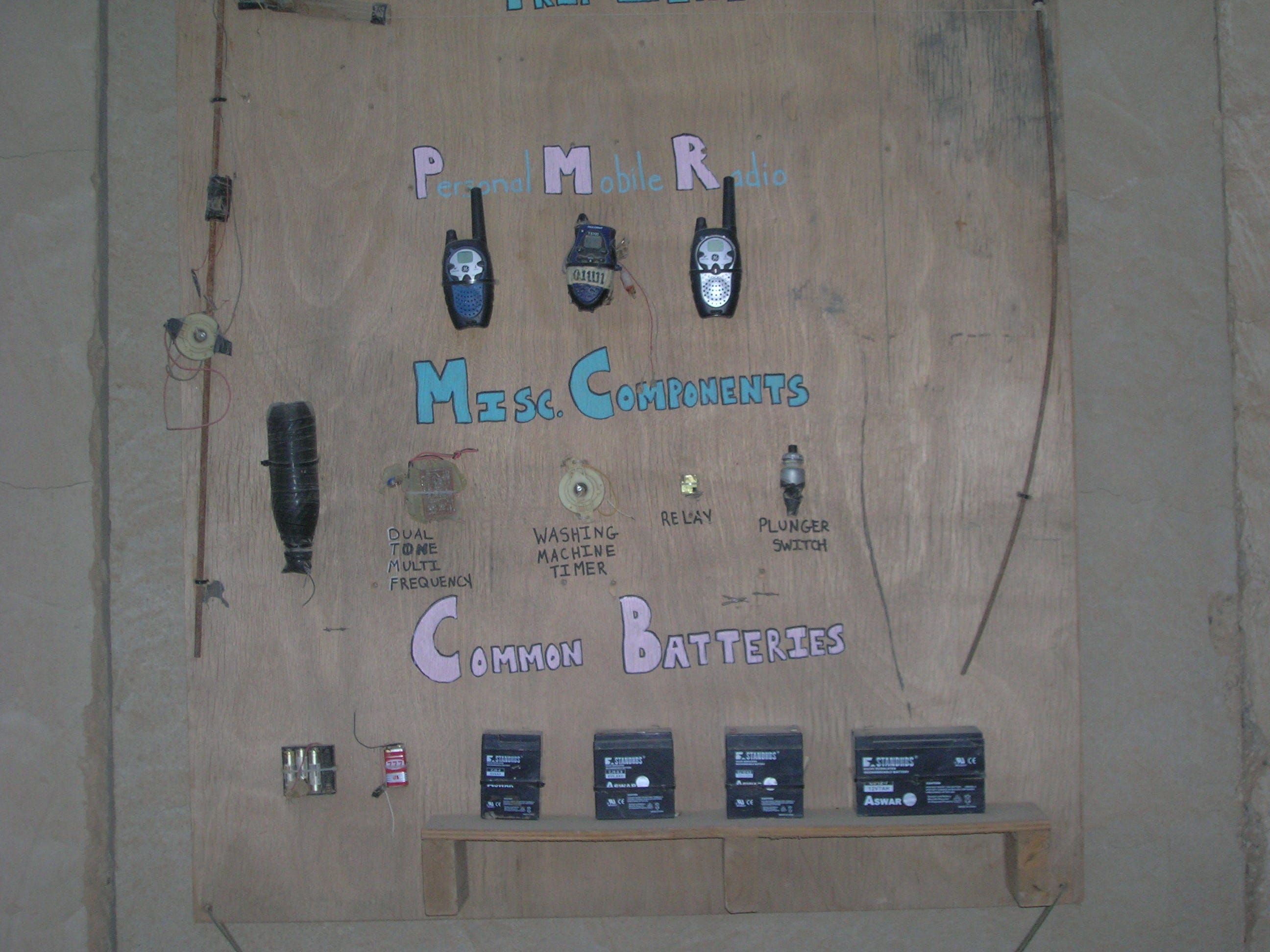
A ton of explosive fertilizer, a small battery, a timer or trigger, then an ignition source… that’s all a bomb maker needs. When investigating a ton of explosive material, I tend to ask myself: “What did we miss?” I am working with Jim and Kyle, members of a human intelligence support team, or HST. Jim pays the guy who pays the guy who pays the guy who gets the information on shipments of bad-stuff and the location of these explosives. Kyle tends to write reports, analyze the data, and talk with bosses. Jim and Kyle created a team of two that has proven effective, even in this bizarre battlespace. They seem to be savvy enough to avoid the obvious attempts at passing on sectarian-based—or revenge-based—data. At the edge of this world, where spies do not call themselves spies, Jim and Kyle spy.
I look forward to yielding my corner back to the rats and bugs from whom I stole the space. I hate this hooch and do not feel very safe at Forward Operating Base Falcon. I never thought I would look fondly on a room that occupies one-third of an aluminum trailer. But back at that base, contractors do my laundry. I drop it one day, skip a day, then fetch my laundry. That’s the counter in my head: drop, skip, get. The clothing returns clean and with a hint of fluffiness. Life is better when dressing in soft underwear and a properly cleaned uniform. When I walk into the D-fac for my breakfast, the fellows at the griddle know my order and treat me well. I know I have it good, nestled in with the division headquarters staff. It is not Vermont, and I see them pour eggs from a carton. My morning egg comes from a shelf-stable egg-like product that pours from a box. In Vermont, eggs come from a chicken that scratched the dirt near someone’s home. In the ranking of good-better-best, Vermont remains at the top of the list, and it is best because it is my home. The divisional headquarters ranks as good. I acknowledge it as the best of all possible options when in Iraq. Camp Falcon is still better than sleeping rough and better than the conditions in which a lot of our soldiers live.
FOB Falcon greeted me with two familiar insignias. First, the four green ivy leaves of the Fourth Infantry Division. Second, an artist painted the shoulder patch of the 506th Parachute Infantry Regiment, part of the 101st Airborne Division. During World War II, it was known as the 506th PIR. The shoulder patch displays six white parachutes in a blue sky near a green hill. Below the image is the word “Currahee.” The HBO series Band of Brothers followed the men of “E,” or Easy Company, of the 506th PIR through World War II. This unit is now here in Baghdad with us. Many soldiers serve anonymously and quietly. We do take pride in our efforts, and the heritage of our units. The men of the 506th landed during D-Day, parachuted into the Netherlands during Operation Market Garden, slept in the snow during the Battle of the Bulge. In the spring of 2006, the men and women of the 506th display their colors at this urban outpost in Baghdad.
I shan’t complain about stiff underwear I wash in the shower, because I have access to a shower. So many do not. I shan’t complain about a morning egg that pours from a carton, given we often have to rely on ready-to-eat meals. I shan’t complain about displacing rats and bugs to create my own nest on a floor, because it is better than sleeping outdoors or in a tent. But maybe I should wonder about invading a nation without much of a plan for either building the nation’s government or the possibility of creating a civil war in our own battlefield. This month, I know of one ton of explosives that will not be used to kill hundreds of Iraqis. Regrettably, if there was another ton of explosives a kilometer away, I would not know.
I.M. Aiken
Author & narrator
“The Little Ambulance War of Winchester County” (2024)
“Stolen Mountain” (2025)
“Trowbridge Dispatch” - fictional short stories/podcast
“Captain Henry: 2½ Insurrections, 2 Wars, 1¼ Centuries and a Story of Love”