

Follow along with my audio here: AUDIO BY AUTHOR
In my daily phone call to my former assistant chief, I relayed the conclusion of a twenty-year drama that I have yet failed to reconcile. Andy tells me a fresh story from his year in Vietnam, thus reminding us both that history matters, the names matter, respect matters. I face injustice with anger, with frustration, and with a sense of utter bewilderment. I wish to yell: That is just wrong.
I woke this morning knowing my story slated for August 2026 must be resigned to a digital drawer and never be published, because even as a storyteller, I feel obliged to tell the truth. I had a difficult and respectful story to tell of a police officer’s commitment to his nation and a strangely circular set of coincidences that linked three friends plus Flat Stanley, Aberdeen, South Dakota, and the Iraq war. A sad story, a story that resulted in two fatherless boys entering their teen years without their dad; a story that left a lovely woman widowed.
Fourteen hours later, my head spins.
I read this morning that while the United States has lost 18 war fighters in combat-related deaths since starting a war with Iran in February, yesterday, the official records got revised down to 14 deaths. We’re discounting lives. But it goes beyond misstating the cost of war, it puts every D.O.D. family at risk. When a warrior flies into a conflict zone, several things change. First, the warrior gets combat pay for the calendar month (that was the rule in my day). Second, a warrior in a conflict zone becomes eligible for combat-related benefits and recognition. If injured, they become eligible for the Purple Heart, an award that carries lifetime benefits. The process of death and burial benefits change, eligibility for Arlington changes. Families are eligible for recognition as a Gold Star family (regulated by U.S. law). When we remove “combat” from a warrior’s death, the family’s benefits change. The status of their warrior changes.
Two men in my life deserve the Purple Heart. The nephew we raised from pre-teen to U.S. Marine got blowed up in a Humvee in Iraq. His mates died. Our kid lived with a severe TBI, but he never bled. Eighteen years into service, he left with 100% disability and three combat tours. But he never bled. My former assistant chief was a young machinist’s mate on CLG-5, the Oklahoma City, a WWII-era light cruiser. Part of his mission involved boiling water in the evaporators (steam, freshwater, etc.). What was not then understood is that the Agent Orange the U.S. used over land returned to Gulf of Tonkin down the rivers and through the deltas. My friend spent months boiling that water, breathing in Agent Orange. At one point during the new/modern Agent Orange program run by the D.O.D. and V.A., these old-ass, hard-breathing tough bastards who are now in their eighties suffering from U.S.-deployed toxins would be awarded Purple Hearts. A compromise was met where the folks would get similar benefits without the formal presentation of a Purple Heart.
I spent thirty-four years with federal agency identification cards in my wallet. Each ID came with its own obligations and its own level of security clearance. I lived knowing that I accepted the duty to hold myself to higher standards for honesty, personal integrity, and honor. In exchange, I have lived an amazing life, with odd missions on some six continents. Sometime after my return from Iraq, the government notified me (and tens-of-thousands of others) that someone stole our highly-sensitive personnel data from the U.S. Office of Personnel Management (O.P.M.). We all then believed these data were stolen by a state actor. I filled out a Standard Form 86 telling the 100% truth of my odd-as-f life. I sat at the kitchen table in Alaska answering the questions of two federal investigators who had already knocked on all of the neighbors’ doors. I will protect your secrets and you, Uncle Sam, shall protect my secrets… Until a chainsaw swung through expenses that few understood. After the theft, Uncle Sam paid for monitoring of our digital lives in an effort to protect us. When the chainsaw hit government budgets, our sole remaining benefit disappeared. You, the letter said, are on your own. No monitoring for you, all done. Too expensive to protect those who decided to protect the United States.
Honor matters.
We are holding up our end of the deal. Civilian, uniformed, municipal, county, state, or national—service is service.
I dedicated my 2026 novel Captain Henry: 2 ½ Insurrections, 2 Wars, 1 ¼ Centuries, and a Story of Love to the officers killed by Americans on January 6, 2021. On January 6, 2022, while completing the draft this novel, I wrote the following:
Those in public service, including the military, swear to uphold the Constitution against all enemies, foreign and domestic. This novel is dedicated to all of those who have taken, then upheld, this oath.
Brian D. Sicknick, Capitol Police
Jeffery Smith, Metropolitan Police
Howard S. Liebengood, Capitol Police
Gunther Hashida, Metropolitan Police
Kyle DeFreytag, Metropolitan Police
Once in a while, governments and organizations forget that the honor of each who stands up requires an equal and opposite strength of honor from the nation. Call it the Third Law of Honor, if you wish.
We don’t get to rewrite history. While we ought not forget history, we must respect it. All of it. Confused, contradictory, ugly, wrong-headed, wrongly-executed—whatever it is, it is all history, our history, our shared history.
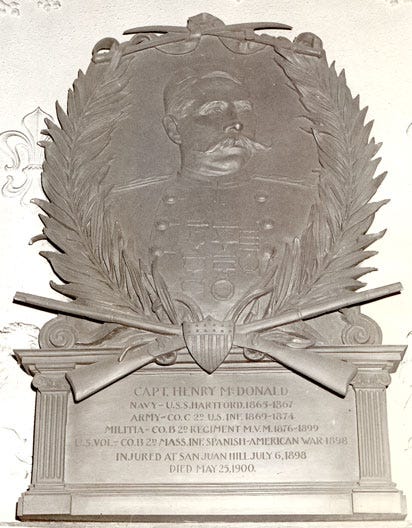
If I cannot have a plaque and a memorial established to honor these cops and the 150 others who were injured on that day, then I shall put their names in a quiet and obscure book about a 19th Century American hero who has also been forgotten by time. My ancestor, the namesake and focal point of my novel, was honored by the City of Springfield, Massachusetts in the early 1900s. The honor was a massive bronze bas-relief plaque with my Henry’s handsome mug in uniform, plus a few words on his public service. Erected after the Spanish American War, melted during a world war for munitions. Gone, erased, and with his story plus the amazing history of soldiers from a modest New England city who provided the infantry support to the Buffalo Soldiers, the Rough Riders, and Teddy Roosevelt in Cuba. A small regiment with a casualty rate of nearly 25%.
This month’s short story recalled a moment twenty years ago in Baghdad. School children in Aberdeen, South Dakota sent our unit a Flat Stanley dressed in camo and a cool set of googly eyes. By luck, the U.S. federal marshal in charge of Saddam Hussein’s security came from the same tiny Vermont town as me. Given we have 500 folks scattered loosely over 40 square miles of mountains, it was amazing that two of us were in Iraq at the same time. He offered to host us for a day at the U.S. Embassy. Four of us from my unit arranged to hop a Blackhawk to the Green Zone in downtown Baghdad and then to the U.S. Embassy. While there, we snapped pictures of Flat Stanley for the school children back in Aberdeen. Flat Stanley at the judge’s bench. Flat Stanley in front of a Welcome to Baghdad sign. We four—two captains, me and my major—borrowed a day to go “play.” We could not know that within days, Iraq would erupt into violent civil war with the bombing of the Golden Mosque in Samarra.
We came to the Embassy’s Wall of Honor. The final plaque on that wall was a tribute to International Police Liaison Officer Roland Barvels of Aberdeen, South Dakota. We posed our Flat Stanley from Aberdeen, South Dakota on this plaque. Roland was killed on January 18, 2006. We were in the embassy about a month later, in mid-February.
The experience immediately brought me home to my small New England town. Two small town “locals” stood before this plaque knowing how Roland’s community would respond to his death. We withheld the photo when returning Flat Stanley to the South Dakota classroom.
I never knew when the right time would be to reunite this plaque with Roland’s family. I was a custodian of one strange story from a faraway land, where a paper soldier made by children would travel half-way around the globe only to pose before a plaque honoring the father of one of their schoolmates.
One year was too soon. Five years seemed tough. On the tenth anniversary, I was being run too ragged with hurricane and natural disaster responses to look back. On the twentieth anniversary, as a novel about the experience is being released, I decided to pull the ends of this circle together. This novel, Captain Henry, alternates between my real journals from 2006 to my great-grandfather’s time following the Civil War, engaging in battles against the KKK and other anti-American groups who objected to the U.S. laws granting rights to human beings.
I wrote a story illustrating this coincidence while putting a soft light on the idiocy of folks thinking that you can have a “fun” day during a war. It was no different than sitting in an ambulance station or a fire station. Whatever is about to happen could possibly be the worst f’n thing that a family ever experiences and you’re doomscrolling on a phone with reruns of Law and Order on the TV.
Before publishing, I endeavored to find the family. First, to reunite a photo of this plaque honoring a father/husband with his family. Second, to ask their permission to use his name. My earlier draft respectfully obscured the city name and family names. A powerful story of how one small American community is linked to a faraway mission and decisions made by our elected federal officials. Third, I carried this story alone for twenty years. It wasn’t a legal secret, just a courtesy that I wished not to inflict harm on a family that already gave so much. For two decades, I wished to find a moment to say thank you to the Barvels family.
With the help of several police departments in the Dakotas, I was able to connect with Roland’s widow, Cindy. We shared our stories on the phone. She was charming, with a light laugh and that treasured Dakota inflection. I loved her accent (because, of course, I haven’t one). As soon as we hung up, I emailed her my photo of Roland’s memorial plaque with Flat Stanley posing beside. I also included Flat Stanley in his other poses to set the context of what we returned to Aberdeen.
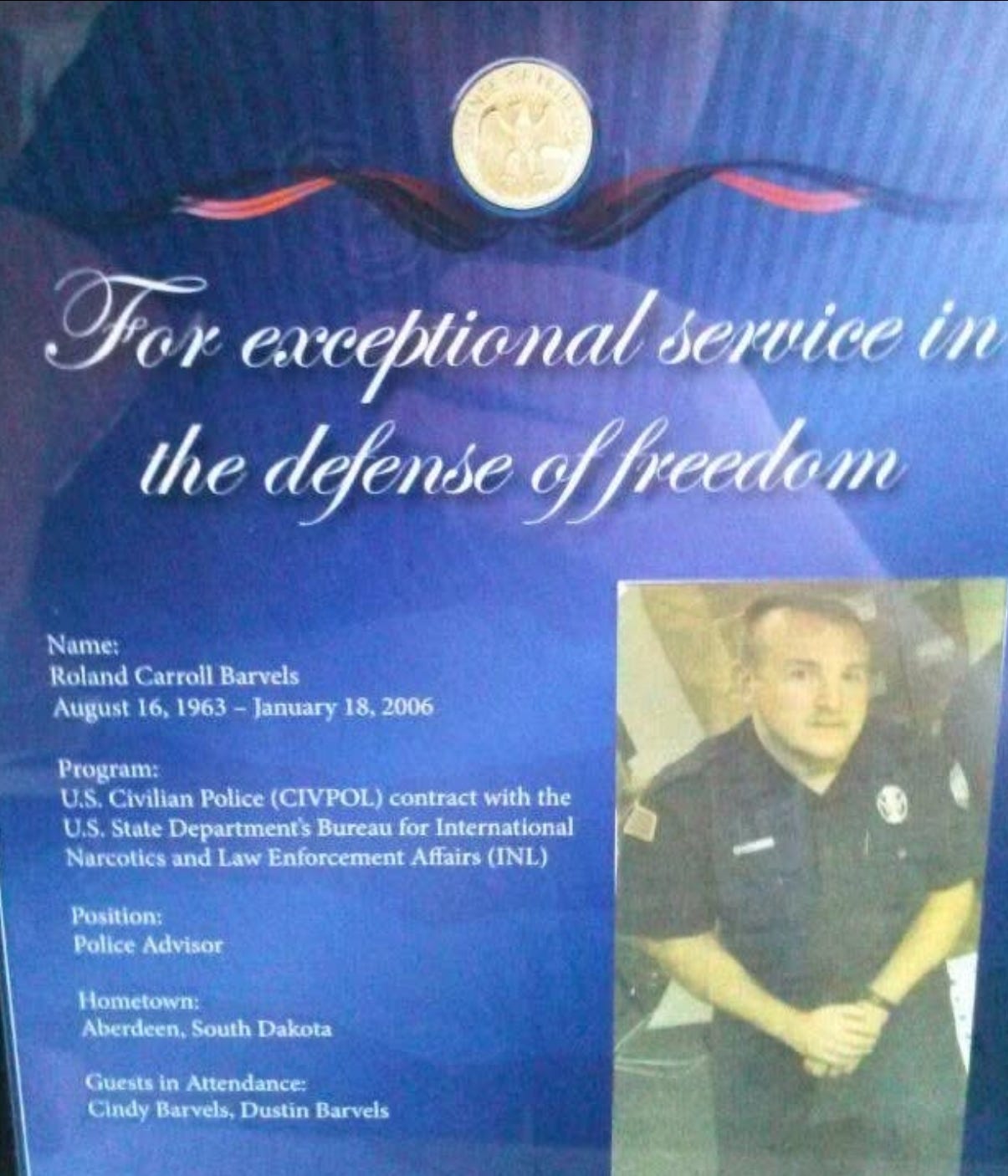
Cindy emailed me hours later. “The picture you sent is not of Roland. This is Roland.”
Each fallen officer had been presented on his own wooden plaque with text to the right and a photo on the left. It appears that the embassy staff affixed someone else’s picture to the plaque of Roland Barvels. Suddenly, twenty-years later, I share the family’s pain. I cringe with shame for my efforts to return this tribute home. Her thoughts became my thoughts. The embassy’s foul-up became my foul-up. I did this.
You, now, own this too. When we send Americans into harm’s way, may we do it with honor. If our fallen fail to come home, may we remember them correctly, and completely. Instead of sharing the plaque from Iraq with silly Stanley and his googly eyes, let me present a more meaningful plaque the family sent to me, after Roland was awarded the Defense of Freedom medal from our nation.
We need to promise ourselves that we will count correctly, honor oaths, spell names correctly, and align images with people.
The End
This is I.M. Aiken. I write and publish at least one story per month on my Substack called Trowbridge Dispatch, a series of stories related to my novels. The first novel, The Little Ambulance War of Winchester County is an existential exploration of one quiet EMT/ Paramedic’ s life who comes to question the value of their sacrifice as they accept that their career closes. Stolen Mountain was my effort to write a bit of a woodsy mystery about a local fraudster who followed a pattern of massive fraud ventures dealing with development in Vermont and ski hills. The third novel, Captain Henry, was described by Craig Higginson, author of Shadow Country: “A deeply humane, authentic and nuanced exploration of moral ambiguity and courage through the lenses of two very different wars and two very different lovers.”
Support authors, buy books, visit libraries and keep enjoying stories.
This was a powerful reminder that history isn't just about events it's about the people behind them. The ending was especially moving. What responsibility do we all have to make sure those stories are remembered accurately?