

Kahlil's Wall
A short story about peace during war

20 years ago December 2005, I flew from Killeen Texas to Kuwait on the first leg of my one-year deployment to Iraq as a civilian member of the U.S. Army’s fourth infantry division. I thought I would share this fictional short story as commemoration of that day. for every day of this next year, I get to look at the journal entry or photograph and remember where I was and what I was doing in 2005 and 2006.
Kahlil’s Wall
audio read by author
I walk barefoot on soft New England soil. I wander my hills. I enjoy the moisture of the night’s dew between my toes. I know I don’t get any of Frost’s words right, but he doesn’t mind. I can swing birch trees, pause in a forest, and pick a path at the same time in my private version of his work.
I am in Tikrit, Iraq while writing this. My barefoot explorations of home arrive only after I close my eyes. We’re a tiny military intelligence unit in a busy, confusing war. We’re here on purpose. The bosses of bosses of bosses sent us here into the Sunni Triangle.
By now you know that I carry a copy of the Declaration of Independence and the Constitution with me. I keep the booklet tucked into my battle-rattle with two thousand calories of food, water, and the normal stuff one may need on a battlefield. My copy serves several purposes. Most obviously, the document serves as a talisman. I swore an oath to this document, why not make sure I know it? Two, it has secrets in it, literally. I underline passages such as, “We hold these truths to be self-evident, that all Men are created equal.” This serves me as a password. I take the first letter of each word in a phrase, then make a mess: Whtt2bse,all=.
The other secret is the Longfellow poem that Brie stuck in there. That’s a double secret, isn’t it, given Brie found a way into my pocket a half-planet away. We all know why that’s a problem, don’t we? I am a female soldier on a battlefield with poetry in my pocket and in my head. That’s the third purpose. This stapled document we got for free in Colonial Williamsburg transports me home.
Yes, I occasionally recite Frost’s work in my head. Frost lived in towns that surround Trowbridge. Shaftsbury, Vermont lays to our west-northwest (from home, anyway) and Amherst, Massachusetts due south. Frost is buried forty-five minutes away. The most famous guys from here in Tikrit are Saddam Houssein, Chemical Ali (Saddam’s cousin and architect of a massacre of Kurds), and—digging into history, now— Saladin. Saladin was a famous guy during the Crusades. A millennia of enemies were born in this town 140 kilometers northwest of Baghdad.
The soil here can be like concrete, and while it is green around the Tigris, we are surrounded by forest-free, trail-free, moisture-free desert, and heat like Vermont never sees. Regardless of my frequent deployments to Iraq since 2003, regardless of my rank, the longevity of the war means that I never really know who our enemy is today—whichever day today even is. I don’t intend humor. The classic soldier’s answer to enemy identification is the ratta-tat-tat of weapons. The guy firing at me is enemy. The guy next to me is friend. I am an intelligence officer and the best I can do is shrug.
My squad’s mission is to rebuild an office, something we now call a “fusion center.” Today, my unit is the boss unit and the host to everyone else in the fusion center. The rest of the alphabet soup of other governmental and defense agencies will roll in with the confidence, volume, and the kinetic energy of an army assault. My point is that they (the others) lack subtlety. I’ll reserve that struggle for another day. I will play the role of Officer in Charge. These boys will expect me to play hostess and nursemaid. I’ll save that fuss for another day, too.
My sergeant interviewed local laborers to help us. Ideally, we wanted Iraqis who support America and our vision for an Iraqi future. At the very least, men who will not kill us and maybe not pass on everything they see, hear, and read to the bad guys. Years of war against Iran. Then a war with America. Then peace? Then another war with America. Then an internal civil war while still at war with America. No one can draw a line on a map that describes “the front”.
We started on Sunday, still a week or so before the Dog Star rises, the annual harbinger of summer’s hottest days. We make plans for a pre-dawn start. We are not a “we.” The army team involves members of two reserve units who have now met but never trained together. We’ve stitched ourselves into a platoon of fifteen with a platoon lieutenant and a platoon sergeant. We have four third-country nationals in dark blue jump suits and high-vis vests, a group of labors universally identified as “TCN”. These guys come from the poorest areas of southern Asia and live in shipping containers provided by an army contractor we would never call “Prime Prisons Incorporated.” And we have our eight local Iraqi men. Languages on site: Arabic, English, Spanish, Bengali, Tamil, Urdu, and who knows what else.
Let’s ignore day one. That’s the day we learned we need six liters of cool water per worker. “Coolings,” a universal word augmented by the gesture of an empty plastic water bottle run against the face. “Coolings,” with an empty held out, is the phrase for, “I need water please.” I allocated three uniformed soldiers to the continuous transport of water and ice.
We can ignore day two as well.
And day three.
Day four, we started at 0430 in the dark with many starting their travels as soon as fajr prayers has been said. Nobody stole wheelbarrows, or mortar. We had the coolings truck making circles. Whither it went, so followed a stream of ice melt and leakage from broken bottles, drawing a dark line in the fine Iraqi dust. On day four, we included mealtime at the local D-Fac (civilian: dining facility) into our routine. We entered the D-Fac as a single unit (Iraqi, TCN, and uniformed Americans), sat together, ate in thirty minutes, then returned to the site. Rise in the cool dark, work under lights, eat after sunup. Rest on a full belly, drink, pray, undertake necessary ablutions, then work again. Eat, drink, pray, work.
On day five, teams shared duties. South Asian guys mixed mortar and passed it to Iraqis. American soldiers laid bricks. The LT established an armory and appointed armorers to guard weapons. I served as boss, big boss.
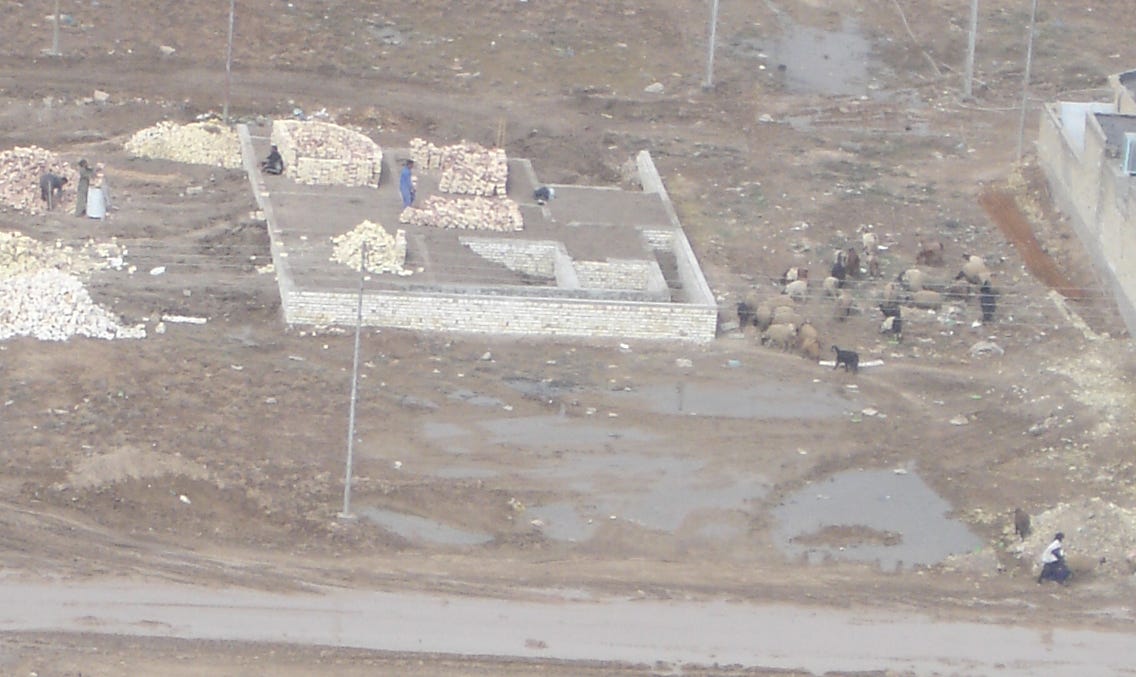
We were building walls from Iraqi brick. Humans have been building walls for tens of thousands of years. There’s no real trick to it. Follow a straight line on the ground and build vertically to the height of the ceiling. The Iraqi guys brought wooden boxes to serve as windows. One box is one window. Take the box out and lay the frame with glass. Done: window invented.
On day one, I wore my battle gear.
On day two, I dropped my battle gear and wore a pistol on my thigh and a combat helmet on my head.
On day five, I was in a baggy shirt with my head wrapped in an American-style blue bandana. Please recognize that “bandana” is a name and fabric we already borrowed from Hindi. I wore my pistol at the small of my back like a plain-clothed cop. I was the only worker on the wall with a weapon. From hand to hand, we passed bricks. From hand to hand, we passed ratty plywood boards loaded with mortar (yes, mortar boards, if you will).
Inshallah was the closest thing to vulgarity used by the team. Passing the liquid mortar was met with greetings of inshallah (“God willing”) and variations of shokran, or, from others, a more Hindi version: shukria.
As boss, I tried to confirm everyone had coolings and found shade now and again. One of my buck sergeants, Sergeant Brown, took up that responsibility. She shepherded the crews. She got sunscreen on the lighter skinned folks. She sent our folks off with soldiers to fetch water as a treat. A ride in an open truck, breeze, a few minutes without lifting bricks. You also get to pick up bags of ice and flats of cool, bottled water. Yes, a treat.
At the end of day five, with our new walls at various heights from thigh to shoulder, one of the Iraqi men came to me. He formally offered to shake my hand and greeted me in Arabic, “As-salamu alaykum, rayiysat ‘unthaa,” addressing me as boss. I returned the greetings in Arabic using his name, Kahlil. Then in English, he said, “You work hard. We see you work hard.”
In Arabic, I said, “You work hard too. All of the team works hard.”
“Good team.”
He stepped out of his shoes and took his place as the mud-mixer. Yeah, we don’t look a bit like an American worksite. The men mix mortar with their bare feet, kicking in Iraqi dust when too wet, adding water from a barrel when too dry. They take turns mixing mud. The careful eye would notice that the youngest get the afternoon mixing duties when the mixing water is as hot as the day. Through the afternoon, the guys use coolings to wash their feet after their turn as mixer.
Even the soldiers are calling bottled water coolings, using the same South Asian pronunciation. Please don’t interpret that as mocking or disrespect. We are hearing the early stages of a patois being developed by a crew. Instructions flow in Arabic, Urdu, and awkward English. Our bricks are universally called “toob,” Arabic for adobe.
The soldiers and Iraqis were the first to start trying jokes on each other, just little gags such as faking that a toob is falling or a little squirt of water. They tested each other for humor and boundaries. The third-country nationals were slower at playing along, but the bolder ones did.
At the close of day five, I paid every Iraqi in clean, crisp twenty-dollar bills. I also slipped the TCN guys a few twenties too, some off-book accounting that will be disguised as material costs or additional labor costs.
On day six, Friday, we rested for the sabbath.
On Saturday, Kahlil greeted me again at the start of the day. We exchanged formalities in Arabic. Then in English he said: “Good crew, hey boss?” And I answered, “Very good crew.” This time, each crew member greeted me with a handshake and words. Then we stripped down to our work clothing. Soldiers secured their rifles in our makeshift armory and removed layers of armor and clothing. The mortar-mixers dropped their shoes. Towels and fabric-wrapped heads and necks against the sweat and heat. We worked until breakfast. We also stop to pray: dhuhr and asr. Sometimes asr, the afternoon prayer, fell after our workday completed.
We did not build a great wall. We built a functional set of walls on the foundation of a building brought down during any one of the recent wars. We weaved our work into the existing, standing walls. By the time we brought in an American construction contractor to hoist the roof with modern diesel equipment, our old-world magic had broken. These guys with their big yellow machines and flatbed trucks yelled in English and fussed about the lack of level and plumb on our new wall. Our brand new, thousand-year-old wall.
My job now involved presenting myself formally in uniform and with military authority. I could no longer be a laborer in my own crew, bossed by Iraqis and young sergeants. But we weren’t done, not yet. I had one more duty before shifting focus back to the modern army.
I asked Kahlil for guidance on how to say thank you to the crew. I gave him three hundred dollars in American twenties. Before dhuhr, or midday prayers, we got word that a Toyota van was being held at the gate. The driver of the coolings truck drove me to the gate, where I met Fatima and her sister and Kahlil’s brother as the male escort. They drove an entire feast including a live goat to our military gate.
While we worked, the ladies prepared the goat and bread and chopped vegetables and herbs. Then, prior to asr prayers, they laid out the meal on a wool carpet placed neatly in the shade of our new wall.
We placed our tools in our boxes. The prayers were offered, then the formalities of the meal started. Our host offered welcoming words in broken English and familiar Arabic phrases. Then I stood in my army tunic with rank showing. A proper cap replaced my do-rag. I offered my thanks to all: the cooks, the goat, and the heavens. I unfolded a page upon which I had printed a copy of Frost’s Mending a Wall.
I read aloud and slowly. I let my voice crack. My efforts were answered with respectful silence.
I read Frost’s words in English, then Arabic. At the line, “Stay where you are until our backs are turned!” most responded Inshallah, and all chuckled in shared memories of toobs that tumbled, crumbled, and slid from position.
“We wear our fingers rough while handling them.” As understanding passed person to person, fingers were held up and wiggled.
“In each hand, like an old-stone warrior armed.” Yes, sorry Mister Frost, I adjusted the phrase. In response to this line, each person made a fist and showed strength.
“He says again, good walls make good friends.” Again, I shifted the language for easier translation and better comprehension. Frost won’t mind, will he? Could he have imagined that almost one hundred years after he scribbled a poem in New England, a military officer would be reading it during a war in Tikrit, Iraq as a gesture of peace?
I bowed my head in respect and touched my heart.
Shokran, shokran jazeelan.
They all answered with respectful silence. Then, as done in prayer, the men formally turned to their left and right to acknowledge and greet each neighbor.
“This poet, he writes of men, not walls,” Kahlil said.
“I always thought so. He wrote of us, I believe. No?” I answered in English and Arabic.
“Yes, he wrote of us. Yes.”
About I.M. Aiken (me)
A number of you reached out after my last post when I summarized my experiences after having falling off of a building and breaking both wrists. Thank you. From your responses I recognized I may not introduce myself and why I am posting short stories on substack.
I am an author with two books out, and two more coming out in the next two years. This sub stack and associated short stories are my effort to find readers and encourage sale of my books, and in fact, any books.
Book 1: the little ambulance war of Winchester County (2024)
book 2: stolen mountain (2025)
these books are available anywhere you could buy books. And if you prefer listening I will be the one to read this to you whether you buy from Libro.fm or audible.