

Read to you by me

Friends, I often use this once-a-month forum for fictional stories in an effort to promote my novels. This story is mine and not fiction.
Stacy from M.E.
I’ve written of Stacy in my Substack posts before. I texted her via Signal a while back. Her response: “RUNNING FOR BUNKER.” Most civilian humans would explore private thoughts of hope and fear. My internal response was: “Bunkers? We never had no stinkin’ bunkers.” I am glad she’s got bunkers.
Learning to sit still in a dining facility during a mortar or rocket attack takes (1) resignation; (2) some stupidity; (3) the ability to curb nature’s urge to flee. I once watched mortar and rocket attacks using the childhood technique of counting the interval between flash and bang to gauge the distance between the lights just-over-there and my own ass. I would have loved a bunker. The lesson came as: “If no place is safe, then you do not run toward safety.”
Stacy became my friend and battle-buddy in 1995. In the name of others and with the spirit of adventure, we did stuff and bonded. A decade plus later, when she asked me to be a reference for her juicy DOD clearance, I said of course. I already did all that nonsense, with investigators interviewing me at my kitchen table and knocking on neighbors’ doors. When she disappeared into military posts in central Alaska that I once knew well, I understood (without asking) her mission. She pinged me after novel #1 with only the signature of “Stacy from M.E.” I knew all with nothing more said.
Because that is what a partner is.
Lessons of a Youth Given to Public Service
Over 40 years ago, I donned my first uniform. The dark blue polyester of our ambulance service matched the city’s police force. Early lessons involved how to knock on doors (and live); how to enter apartments and homes (and live); how to approach folks injured in melees (and live); how to restrain and transport emotional disturbed folks threatening violence to self or others (and live). Your successes and your joy came from the partnership you formed with the other human in your ambulance. In the fire service, the famed statement of “two in/two out” reflects this experience. In military operations, it is your “battle buddy” who serves to double your senses and protect your back (in the literal, by the way).
Another lesson of my youth, not codified until the 1990s, was “PST,” or Primary, Secondary, Tertiary. Every plan needs an alternate plan. Every set of plans requires an extraction plan. “Oh, that went wrong” is often met with humor in the field. The laughter gives way to fear, dread, and a full zing of sympathetic nervous systems responses we mammals get: fight, flight, freeze, fawn. I learned: plan to fail. Critically, I learned to never go anywhere without an exit plan and the ability to hunker, hide, and survive.
I wrote of my first great partner in the character of Aaron in The Little Ambulance War of Winchester County. Like each of us, partners come in 32 flavors, such as my EMT partner, who was in the USAF as a firefighter but screamed in the face of a grass fire started by a catalytic converter (“pull, squeeze, sweep” I offered ironically after I put it out). One of my partners brought a VHS tape of his operations as a medic in Granada. One partner was the mechanic for the local musician J. Giles, who loved car racing. My fictional Aaron was based on a Vietnam combat medic who decided to attend nursing school a decade after returning from overseas. The real Aaron, like the fictional one, had been shot down from three medevac Hueys.
Offered without statistical proof, I have observed that—both at home in civilian uniforms and overseas in combat zones—EMTs/paramedics, firefighters, and cops often do both. This group serves at home and with a military unit at some point. The crossover is significant.
Partnerships formed thus last lifetimes, even when the bonds stretch and the phone line falls silent.
In the decades since, we’ve expanded the definition of “partner” and “partnership.” In this entry, I refer to the historical and (typically) non-sexual aspects. When discounting sleep, one may spend more time talking with and adventuring with your on-duty partner than the spousal-like entity in your bed at home. In many of our lives, both roles exist separately. Each with their own intimacy, rules, boundaries, and fidelity.
I explored this a bit in my short story, “Murmuration.” With a great partner, you develop non-verbal communication and a sixth-sense of movement, thoughts, and plans. Like watching wolves hunt quietly, it takes but a look to define risks, sight objectives, and then say: “Go.”
This brings me to Stacy: my queer, wiry, amazing friend. In 1995, when we met, I recognized a human who was like me. For years, she was my battle-buddy. I mention queer only because, once, while clicking through one of the miserable streaming services, the original Lara Croft movie glided past. We two snuck away from our respective homes and families to enjoy the sexy, campy, quazi-porn flick. Cuz we could. We never dated. That’s not us.
I privately hung the blue service flag in my office to honor Stacy. A war with invisible regional boundaries, no objectives, no plans, and leadership with limited experience in armed conflict.
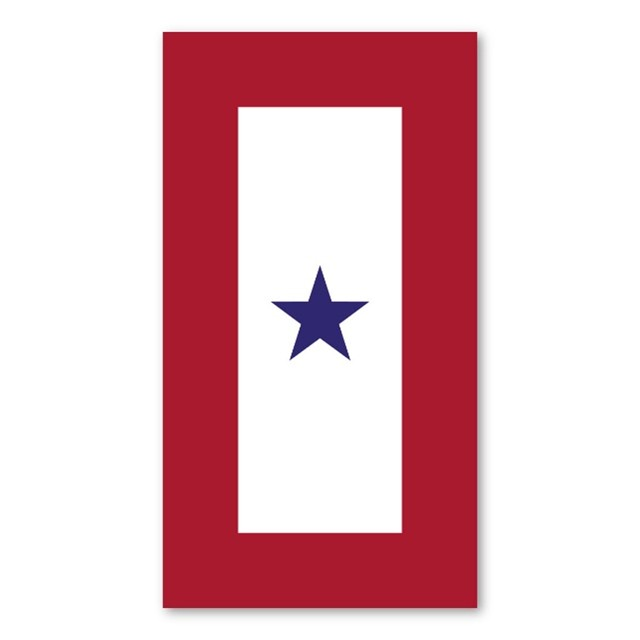
Blue Star Service Banner
For years, the cars in my family mounted and removed the Blue Star Service Banner. The marine we raised deployed before me, I think twice, each for three months. The flag on the car (or front window of a house) says: “I have a family member putting their life on the line for fellow Americans.” I got deployed for a year that excluded months before and months after the time in Iraq. I think the flag flew from departure to return. We hung it again with the marine deployed for the last time. His HUMVEE got blowed up on an IED, killing most of his squad and leaving our marine with a significant TBI. The injury essentially ended his active-duty career as a special-operations-qualified marine. He was medicaled out at eighteen years with 100% benefits, and full VA care.
The Gold/Blue star flags give recognition to families of those who serve. This silent statement affirms that some part of my heart and soul is given to an American warrior, sent forward on orders of national will and political need.
I’m here, but I am also there. I am there because part of me is there.
The Gold/Blue star flags show how one place can be connected to distant conflicts. This illustrates that leaders in one city adversely impact the families, lives, and plans of Americans hidden in the hills, living on city blocks, housed on military posts, or tucked into suburban homes. Congress recognized this privilege with 36 U.S.C. § 901.
War is Different with an Empty Chair at the Table
Having just come through the holy week, I was, again, reminded of the empty chair and open door reminding us to welcome Elijah. That gold star, that blue star, says that my table has a place set for someone who is not with me. With Gold Star Families, that chair shall remain unoccupied forever. For Blue Star Families, we live daily hoping that the door hinges creak and the empty chair gets warmed by a living and loving human.
When the direct impact of war comes to a community transported by emptiness and loss, we must not view far-away videos with the perverse curiosity of video games and ugly memes.
Veteran Families, Gold Star Families, and Blue Star Families get to ask the tough questions, often with tears: why are you sending my family there?
Some Part of All of Us
I am proud that so many veterans of the Iraq and Afghan wars have been standing for elections. They get to ask the tough questions. They get to demand answers. I wish someone would remind us of how long the Iraq War actually lasted. Statements made this week may have been legally accurate, but misrepresented the truth:
· Iraq War: 2003-2011 (“8 years, 8 months, and 28 days”)
· Iraqi Insurgency: 2011-2013
· War in Iraq: 2013-2017
· Islamic State Insurgency in Iraq (2017-present)
The U.S. and Iran have been engaged in proxy wars in Iraq since 2014. In short, the Iraq war has not ended, the borders have simply expanded. One must never be contemptuous or dishonest about the cost of war.
We have been at war in Iraq for 23 years —yes, longer than Vietnam.
The human cost to American families (2003-2011):
Wounded
32,000 uniform military
44,000 civilian contractors
Injured/Disease/Other medical
45,000 uniform military
Unknown civilian contractors
Killed
4,508 uniform military
3,650 civilian contractors
With rounding and including allied forces, that was 27,000 dead and 120,000 wounded/injured/ill in the first eight years.
When these families are your neighbors, or when you are a Gold Star/Blue Star Family, you know this deep in your soul. You shop with them. You see them around town. You see the flag sticker in the window of the car or house.
The rent in my heart, the empty chair at my table, and the Blue Star flag hanging quietly in my office is for all of the Stacys, Aarons, Andys, Jacobs, and others who stood.
The irony with my deployment is that I was in complete political opposition to the war when I was asked to join. Unlike most, my letter from Uncle was not legally binding, I had the right to say, “No,” and not report. I said, “Yes,” because I believe that democracy requires participation. I went.
Stacy is there because she is an expert at that thing she does and because she continues to make the voluntary decision to remain.
In fact, 100% of our military volunteered to undertake these missions. 100% of them swore an oath to the U.S. Constitution to stand and fight for Americans in the name of America. And for 23 years, Americans have been actively engaged in combat operations in places many cannot point to on a map.
My Favorite Stacy Story
In the late 1990s, I worked for the Indian Health Service, a part of the U.S. Public Health Service while living in Anchorage, Alaska. One winter, I was tasked with delivering a replacement medical device to the native health clinic in Valdez Alaska (yes, that Valdez). I asked my battle-buddy to join me on the three-plus day car trip.
For those of you who have driven the Glenn Highway in the summer months, the winter version of this same road is different. The road is isolated, lonely, quiet, and most road-side services close up ‘till the snow goes. Through the Thompson Pass, you may encounter walls of snow at the edge of the road that are higher than ten or fifteen feet. The state uses a turbine to blow and lift the feet of snow.
There are names you know along this road: Matanuska River, Willow and Palmer, Alaska.
After the right at Glennallen, you drive south towards Valdez. Climb and climb glaciated mountains, come to Thompson Pass. I hadn’t had a chance to pee. Getting desperate, I decided to stop on the two-lane highway. Explaining my plan to Stacy, I rammed the truck’s bumper into the wall of snow several times to cut a hole. I then dropped trou, hovered my butt over the hole in the wall, and took care of bidness. No flushing needed. The next plow run would freshen it up.
Stacy kept a bag of salted sunflower seeds on the dash. I’d grab one or two, suck the salt, and cough. We spit shells into empty water bottles like so many folks using chaw. She yelled at me for coughing. “Why eat them if, every time, you cough?” I still don’t know.
As we rode the last hour past the switchbacks down toward the coast and sea level, I put on Beethoven’s 9th Symphony. As I sung loudly, I drove faster and faster. The music got louder and louder.
I knew that if we had trouble on the road, or had to camp in the snow, or prep a meal, or find a way to stay warm during a delay, this partner was for me. Together, we could survive (nearly) anything.
You plan a three-day winter mission in the Chugach Mountains with the right gear, the skills, contingencies, and a person by your side who can haul your ass from the shit and laugh about it while spitting sunflower shells.
As an aside to my aside, there are numerous stories of the Alaska National Air Guard parajumpers (PJs) flying out to save all sorts of U.S. military special ops teams who have had it all go wrong. A nice brag for the hometown team. When Seal Team 6 gets in trouble in the Chugach, who do they call? Alaska PJs.
Get your ass home (all of the Stacys).
I.M. Aiken author & narrator
“The Little Ambulance War of Winchester County” (2024)
“Stolen Mountain” (2025)
“Trowbridge Dispatch” - fictional short stories/podcast
“Captain Henry: 2½ Insurrections, 2 Wars, 1¼ Centuries, and a story of Love” (2026)
Follow along at: