

The Shepherd
A short story by I.M. Aiken
Listen to me read you the story here:https://open.substack.com/pub/trowbridgedispatch/p/the-shepherd-audio
I chase a pink trillium into the forest. Correct that, for I am not a galumphing red hound pursuing deer. I had ambled past the line of greening grass, placing my feet on the forest floor. I need a special box of Crayola Crayons. Do they make a box of 256 browns? Imagine Crayola introducing the New England Series. In the May collection, the box would need more browns than there are browns. Like a dot painting, a color-blind test, or an abstract work of art, the colors appear in splotches looking very much the same up close as they do from afar. This mottled floor spent a winter crushed below layers and layers of snow.
There’s my surprise. Pink, red, yellow, white. The ephemeral green supports delicately bold colors. You don’t have to see them. They don’t care if you do. It is easier to see and count the 256 browns than it is identify the blood red trillium with its face looking skyward through an empty canopy.
Each time I find one, it is a surprise. How did you just appear? You, little sister, poke up through the litter.
Amble, perambulate, scramble, ramble. The forest doesn’t really care where I go. Fine. The little chipmunk warns before dashing back to his stone wall. The squirrel argues with me while measuring me from her tree. She’s upside down, flat against the tree in nearly identical colors of greys, rust, and browns. She looks at me. I look at the floor. She yells at me. I find a trout lily. Kneeling, I flick a crispy beech leaf wishing to aid the lily’s freedom.
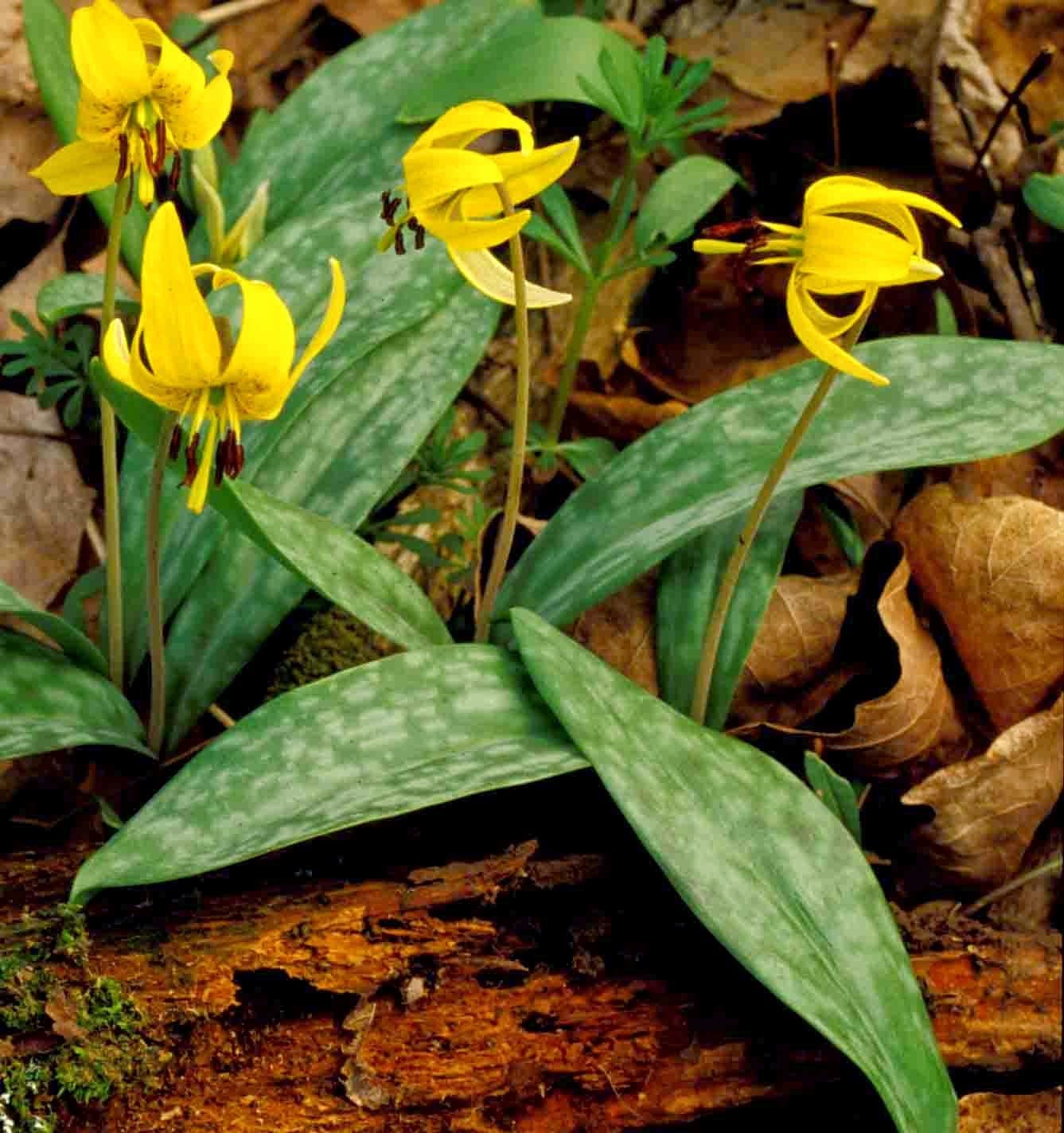
She doesn’t need my help. The Placard Orange of Sally Mander flicks out of sight as the tiny moist lizard-y critter hides under a leaf. Is that a Crayola color? Placard Orange? It should be. I’ll just expand my make-believe box of 256 browns. Placard Orange is just right. It is perfection. My finger explores the world below a decaying birch leaf. My finger touches moisture. My finger touches warmth. My finger touches life.
I cross one stone wall at an acute angle, another nearly perpendicularly. Amble. Not chase. Although I am chasing, just not racing. An amble can be a chase if you don’t know what you chase. The sound of human whistles alerts my ears because the sound is entirely human.
I had been listening to a hermit thrush, the state bird. Hearing it reminds me of the sound effects that Gene Roddenberry would have wanted in the original Star Trek. Haunting and multi-tonal. I follow the sound downhill. What if a communicator opened with that sound? Or the tricorder, ‘Captain, the tricorder’—add repeated short sample of hermit thrush song—‘indicates that there are life signs over there.’ I actually did flip my hand as if I could open a communicator to call for Scotty or anyone. How old am I in this forest?
On the last wall, the forest ends. A pasture exists beyond these stones. To draw this, you’d need the Crayola box of a middle schooler, or the watercolor pencils of a pre-teen. That green has been trademarked as “Irish Green”. I would draw the sheep in “Woolie White.” The nineteenth-century farmhouse rambles irregularly. Red brick chimneys penetrate the roof without rhythm. The upside-down crenellations of the chestnut barn boards provide access for mice, voles, chipmucks. Come, go, be a mouse.
I am sitting on an ancient New England stone wall. The leathered rock pulls heat from my bottom, but I am not the first to have done this. This is no perch built by and used by local hunters, given the view spans a field of sheep simultaneously trimming and fertilizing the grasses in the field just below me. Sam calls them “woollies.” I often say “sheeps” because there is more than one. This is a perch used by someone watching the sheepsies.
It isn’t the woollies or the chill radiating up from my stone. And my exuberance for hunting trout lilies, red trillium, pink trillium, and white trillium quieted as I spied on a woman beating the ground with a bristly broom made with long tough straw, as seen in a children’s story. It is the broom that comes alive to dance with a young movie mouse. It is the broom found next to old fireplaces. It is the broom displayed on those silly signs you find all around Salem Massachusetts every day of the year. Except in this Brigadoon view, I watch a woman use a real one, not something from a Halloween cartoon.
This woman stands alone in her field wearing a full skirt and leather ankle boots that either came from a Victorian washer woman’s lost closet or the back stock of LL Bean. Up goes the broom over her head, then down with a swish to the ground.
She whistles brightly. The little pup of a dog senses the down-coming broom, pivots to turn the other way, running now counter-sunwise in his ring. The lady whistles again as he starts. The black-and-white runs low at the edge of his ring.
The lady steps forward away from the edge. The dog runs around behind her.
She sings: “Attle-do,” then whistles a different set of notes.
“Lie-down,” followed by a whistle.
The dog lays with his face towards his master, or with full skirts maybe I ought to say ‘mistress.’ I thought I’d given up on such distinctions: waiter, waitress; actor, actress. It’s been nearly a century since we convicted our last murderess. And a lot of decades since any authoress published a book.
She steps towards her eager pup with empty hands, the cartoon-broom rests on the ground. The moment she reaches for the pup, he rises in joy, losing the disciplined connection that prompted him to do her bidding. She then rolls to the ground to play with the dog.
In a skirt with gray hair gathered into a loose bun, she let’s herself get mauled by the small pup. She treats the dog with love and snacks.
I watch her pull a 1980s style plastic water bottle from her skirt. This bottle fell from fashion before I was born. She waters her cupped hand. The pup laps water from the stream and her palm. Knowing he is free, the pup runs goofy. He returns to her with a leap. She lets him crawl on her chest and nibble at her hair and face.
“Hey, no teeth.” She disciplines the nip with a quick word, a stern look into his eyes while holding his cheeks, then turns the joy up again. The shepherd—certainly not shepherdess still, is it?— rolls to her knees and stands up with a bounce, as if she were thirty, or even twenty.
In a one-word song, “Giel!” The dog looks up.
“Giel, come.” The dog approaches her.
“Giel, away-to-me.” She drops the broom on her right, the dog starts his run to the left, but his head is down and he moves slowly. He finishes the loop.
“Attle-do. Down.” The pup lays down. Maybe a flop? The pup flopped to the ground.
The shepherd opens the gate to the training ring. “Nice job, Giel. Great.” She bends, offering love and affection to the young worker. “Let’s go home.” The tired dog starts to run as if he were but months old, then his little body remembered that he is an exhausted athlete returning to the locker room after a hard go on the practice field.
Head hanging and tongue out, Geil follows at Mother Hubbard’s heels as if not knowing the way home. He’s a tired, tired puppy. They disappear around the corner of her house.
Two mornings later, after a rain, the trees suddenly showed color. Instead of a box of 256 browns, I’d need the box of 256 Impossible Greens. Black green, yellow green, green green, blue green. Ash leaves, birch leaves, maple leaves, oak leaves, beech leaves, ironwood leaves all look alike with every one a different shape, every one a different green color, and all of them brilliant against the dark evergreen green of the white pines, hemlock, and black spruce. Every leaf awakes wrinkled then unfolds skyward.
That’s the trillium’s moment, isn’t it. And the trout lily. When the canopy closes in for the summer, the ground receives the dribbled leftover light from above. The little vernal ephemerals find the right weekend between snow melt and canopy cover to find their own light. The summer is dominated by ferns and mushrooms, both of which appreciate the shade.
That’s us isn’t it. Finding our light? Finding a way to thrive in our niche. This is your week, little forest floor flowers. Go! Be yellow. Be red. Be pink. Be you. You’ve got a week.
I am less amble-y and more linear in my progress through the wood. The fact that I admit to progress informs me that I have a destination in mind, doesn’t it?
You’d think that the indelible blue jay wouldn’t need their own week to shine. They are blue. They fly funny. Seen them? They flap for a bit, then fold their wings back to make like a bullet. Bullets don’t really fly, they fall. The jay has to flap a bit more, then the bullet again. Flap/fly, bullet/fall. Repeat until you make it to the next perch. Other corvids glide. No, not for the jay. Step out the door any week of the year and a jay announces something like a warning. That’s their game. They yell. “Danger.” “Hawk.” “Sex me.” “Hello.” “Where’s my dinner?” “What time are you coming home?” It’s their show, they think. They narrate it while bickering. They bicker together. They bicker alone.
Then comes February. All of the jays go quiet, all at once.
By now, they are back bickering and ruckusing, of course. I am new to this wood. I seem to be OK. They welcomed me or warned me or warned others when I entered their wood. Then they let me be. I don’t speak enough Jay to understand them, do I?
I close my eyes on this stone perch overlooking the shepherd’s pasture.
My neighbor, for she is my neighbor, or at least very close to our land’s border. I walk to her pasture where she has three dogs. Two adults and one pup, likely my friend Geil. The four stood at the gate, the shepherd and her dogs. The four studied the sheeps. Suddenly, lambs appeared amongst the others out there. How did I miss lambs?
On a third trip, I arrive when the shepherdess had little Geil in the training circle. I could hear her words and recognize her whistles. “Geil, come by,” the little pup turns to run the circle counter-sunwise. Thwap. The broom strikes the ground. “Geil, Away, away by me.” The pup pivots, running the other way following the sun’s own circle–sunwise.
“Muon, out, cast.” She didn’t look away from her cadet dog. A black-and-white sprinted towards the pasture taking the far-left edge. I was watching Geil run his circles, get stopped in his tracks, lay down, and run again. She whistled a song, a command that Geil didn’t follow. He listened but did not move. I scan the sheep enclosure, and the other dog, Muon, had disappeared.
She whistled another command to one dog while directing Geil to “Come by” again.
It is then that she looks up and looks out. Her eyes find what I do not, Muon.
“Muon.” She sings “come-by” in three syllables. “Co-o-o-me, Come-by”.
She follows that with a whistle to Muon then another air-sweep with her broom steering Geil. Her whistle adopts a staccato of stop-and-starts. I turn to find her dog directly behind me. I rise to leave. Muon blocks my path.
The shepherdess looks only at Geil who ran his interrupted circles learning to stop, lay, and return on command.
Muon’s command changes with a whistle. He barks at me. Once. She whistles. He barks. She gives her staccato whistle, and this little dog does his best to push me over the wall and into the pasture. He barks again—on command.
With the compliance of a sheep, I walk towards the shepherd.
She doesn’t watch me. She had Geil bound to her. He bid her every desire. “Geil, away.” He sprints left while knowing exactly where the shepherd stood. Then, it was over for Geil. The dog got water, praise, and a lot of loving.
“Thought it was time we met,” she says to me in greeting.
Clearly.
“I am Marna Jacobsdaughter.”
“I am Brighid Doran.” We did not shake hands.
“I hear you’re new to the area.” Unlike some in Trowbridge, she said it with understanding and kindness. Sometimes, I hear “I know you,” from people who do not know me.
“I guess I am your neighbor?” I say.
“Almost. The lands almost touch.”
Geil runs free of the enclosure then comes to me for a greeting. I sit on the ground to let him maul me. “Geil, sweetie.”
“Don’t let him nip.”
He nips. I mimic Marna. I hold his face to mine saying: “Geil, no.” After the correction, I rain affection on the fluff.
I stand. I make no eye contact with Marna. I am not her pup. I am not being trained by her nor do I seek her approval. I am a fully grown woman. She saw me emulate her own actions. Did she nod? Or was that just an expectation of hers? Yet, I desire her approval. I did it just as she did. I nearly mimicked her tonality and cadence.
I should have understood that I sat upon her stone throne. Of course, she knew I was there.
“Tea?”
“Yes.”
She had used a border collie to fetch me from her stone wall. She beckoned me with precision. I felt the tug between approval and unease of not getting her approval.
Her kitchen is none-of-the-above, unless your list includes old, messy, chaotic, and oddly smelly. It smells like no other kitchen, ever. Like my magic box of 256 browns crayons, this kitchen has 256 smells of earth. I smell dog, of course. Both puppy and adult dog, for they do smell different. Pups smell sweeter. I smelled sheep, specifically wool and lanolin. I smelled earth, that hint of funk you find inside of a blue cheese. There was something both sweet and sour. Not the American-Chinese smell of that glossy sauce. That’s just vinegar and glossy sugars. I smelled the sweetness of rich milk and the sourness of milk just gone. A maternal smell, not exactly like a new human mother, but the smell of barn motherhood. I smell barn too. Old hay and ancient cobwebs.
None of these smells are my smells. All new, yet deeply recognizable for their frank honesty.
She puts dried green leaves and white flowers into a glass tea pot. She lifts the lid revealing an earthenware pot of raw honey. She places a chipped WGBH coffee mug on the table with a small dish and a spoon. The smell of chamomile infuses my memories. How could I have a memory of this? I’d never … Not a memory, I insist.
“I take it that you are Sam’s person?”
“I think so.”
“And she is yours?”
“I hope so?”
“Good. She needs someone.”
“Sometimes, I wonder.” I answer. “So, you know Sam?”
“I do. Her aunts and I were close. Sam came over often when she was younger. She helped me when my own kids were busy. I shouldn’t tell you this, but I think your Sarah had a crush on my youngest girl. It was cute. Sam was too young to understand, and my Ursula was too old to notice.”
How should I feel about that? It wasn’t jealousy. Just history.
“Cute.” Because I am a trooper.
“Is Sam overseas?”
“No, but travelling. Actually, she is overseas, but in Europe.” As an insight to our coded language, overseas means in or near a combat zone. Some people might say, “downrange” but that feels too literal for our domestic conversations. Thus, therefore, overseas does not include friendly NATO and US bases in Europe or Canada.
“Will we ever learn?”
We sip tea. I study the view from her kitchen window. From this seat, I see most of her pastures and the stone wall upon which I sat. Her barns are to my left.
“How long are you here?”
“A while?” Confused by the question.
“Housesitting? Living together? Roommates?”
There is no escaping the honesty from this woman.
“We’re a couple.”
“And she left you alone in the house and her elsewhere, huh?”
“That’s our life. I am part of Trowbridge Rescue and the fire department, I try to go to community club meetings and get to a selectboard meeting now and again.” Did I just admit to living alone in a big house in a remote town in southern Vermont to a stranger? Let’s hope that is not mistake.
“Did you know Sam’s aunts?”
“Only through her stories. Sam and I met during my freshman year. I think she lost them when she was like fifteen or sixteen.”
“Something like that.” Conversation about the aunts ends. There is something else there. I feel it. I see it. Marna’s face is not like my own. My thoughts leave a contrail across my eyes, my cheeks, and my mouth. Strongly bitter chocolate, a perfect lemon curd, or thoughts of sex announce themselves as a pair of red stop signs mounted on my cheeks. Marna is not as reserved as Sam, but pretty darn stoic.
In wanting to describe the leaf of a trout lily, I envisioned the uneven coloring of my own tongue. My tongue, obviously, is not green. We both have roundish splotches. My tongue has been described as sharp, a shape I saw on the trout lily. I suppose someone once looked at that leaf shape then said: trout? I wouldn’t. It was more Sally Mander shaped than trout, lizardy. In that leaf, I saw the sharpness of my unkind tongue.
Let’s back up there. My tongue is special to me. I taste and smell the world. And no, we are not stepping past the bedroom door either. Just thinking that in front of Marna causes my cheeks to warm. There are times that my tongue adroitly shapes words I speak. They often hit and hurt. The result is instant regret. Does a porcupine regret the damage to a dog’s nose? Likely not. I do. I feel every barbed word I have ever spoken. The trout lily has a rapier-shaped leaf. Gone in a week.
Marna’s face says, “Approach with care,” as if displaying Placard Orange. Marna’s eyes are deeply, strikingly blue. Her hair either tells me the truth of her age or lies. I don’t know which. For a farmer, her face is neither sun damaged, nor lined.
“Cheese?”
She presents a basket of cracked crackers. Is that where the name came from? Cracked flat bread? I used the sterling silver butter knife to smear cheese. That was the other smell. This cheese.
“Chevre?” I ask after a taste.
“Except not. Sheep.”
“Of course, but not pecorino?”
“Pecorino tends to be a firmer and aged cheese.” She answers.
I want to let Marna know that I understand pecorino to mean sheep cheese. This cheese, Marna’s cheese, like a chevre, is herby, garlicky, and possess that earthy funk I smelt on my entry.
“Are you alone here?” I ask Marna.
“I am now.”
I remind myself to scan the kitchen discretely for photos of the daughters and evidence of a husband or was-band, or maybe a special woman.
Curiosity.
I suddenly understood Sam’s crush on the youngest daughter. I discover myself drawn deeply towards this woman. She’s older than my mother, maybe even as old as my own Nana. I understood the pre-adolescent crush Sam had. So confusing yet captivating.
I could happily be her pup. I’d run in small circles for her. This time sunwise, then spin to run widdershins. I’d run for her until my tongue hung with exhaustion. I’d starve for water and love until she fed me. Confusing, no? I have my person, or so I believe. I have my Sam. I don’t feel danger from this woman.
I feel gravity.
Sam was a magnet, is a magnet. She pulled at me from across the campus in her tweed jacket, a James Dean t-shirt, and perfect-fitting blue jeans. Snap, click. We fit together. She pulled that blue dress off of me after our first date with surgical skills. On that night, I coached myself: slow, go slowly. I deftly flipped each button free of its home. I worked my way down the flies of Sam’s jeans. I can feel it now. That pull. The desire.
Oh, fuck. Marna can see my thoughts. Shit, I can feel my own thoughts—right there.
Marna’s gravity pulls me in, cradles me, yet it is Sam’s body I see. Sam’s body I want. Sam’s skin I am not feeling, but desiring.
“You’ll do alright.” Marna pronounces. “You love her deeply, don’t you.”
“Who is the boy?” She asks after a moment of silence.
“What boy?” Except maybe I know.
I had to sip tea. I need moisture in my throat to form words. All moisture had migrated south, I guess. I dip my spoon in the raw honey, placing it in my mouth cup-side down. I caress the warming honey with my tongue. My tongue explores the honey which feels alive.
How do I ask this woman, “what did you just do to me?” The answer has to be nothing. I am a guest in her kitchen eating soft sheep cheese on homemade crackers and drinking tea. I think I know that she grew the chamomile. The honey on my tongue came from a hive somewhere very nearby. Yet without moving a muscle, she had cleaved my soul for a quick look around. I hope she liked what she found. I have my own doubts. Sharp tongued, quick witted, too young, and female, I often feel out of place and out of time with others.
This woman opened me up. Searched around, probed me, then let me go. I felt opened. Filleted with an invisible knife.
I breathed.
I sipped tea.
Credit Roll
Author: I.M. Aiken (written June 2025, published June 2026)
Editor: SarahBelle Selig
LLM Statement: Just us CBLFs doing the work here. No generative AI was used during the writing or editing of this story.
Hey All, Thanks for reading and communicating with me. It is 01JUN2026, I’ve seen the last proofs of the upcoming novel Captain Henry: 2½ Insurrections, 2 Wars, 1¼ Centuries, and a Story of Love. It is an historical fiction novel based on my own ancestor, blended with my journals from Iraq 20 years ago.
Captain Henry is available for pre-order. Search “Aiken Captain Henry” or Search ISBN 9781963511703
Please support local bookshops and/or use this link with Bookshop.org
Books will ship in mid-September.
I.M. Aiken